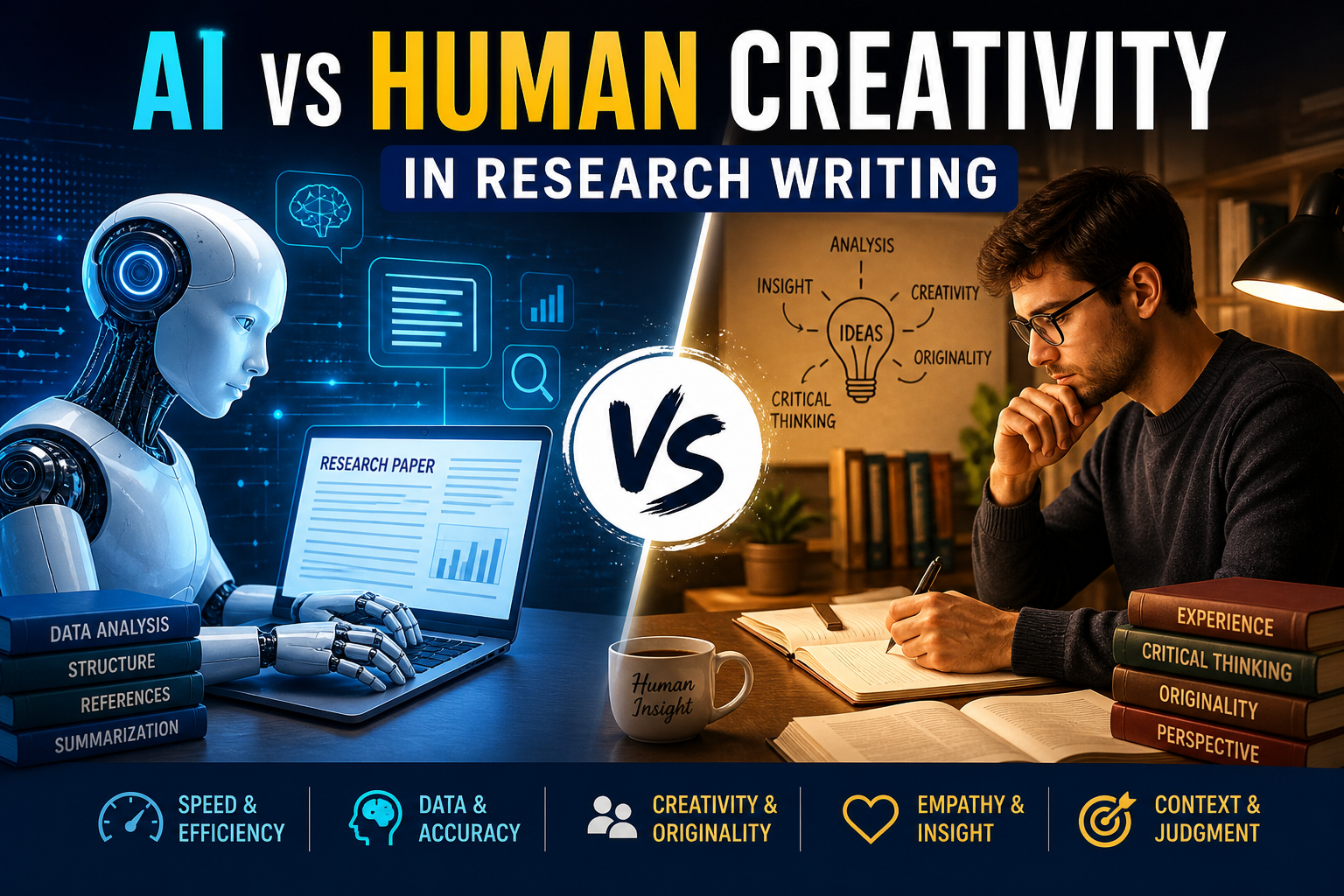
AI vs Human Creativity in Research Writing The debate around AI vs human creativity in research writing has intensified in recent years, especially as artificial intelligence tools become more advanced and accessible. From generating essays to assisting with data analysis, AI is transforming how research is conducted and presented. However, the question remains: can AI truly replace human creativity, or does it simply act as a powerful assistant? In this detailed guide, we will explore the strengths and limitations of both AI and human creativity in research writing, helping you understand how to use them effectively in 2026 and beyond. This is where professional services like Essay Writing Assignments become invaluable
What is AI in Research Writing?
Artificial intelligence in research writing refers to tools and systems that can generate, edit, and analyze written content using machine learning algorithms. These tools are trained on vast amounts of data, enabling them to produce structured and coherent content quickly.
How AI Works in Writing
AI writing tools use natural language processing (NLP) to understand prompts and generate relevant text. They can summarize articles, suggest improvements, and even create entire research papers based on input data. For students who need reliable and professional support, Online Essay Writing remains a trusted choice.
Common Uses of AI in Research
- Generating research outlines
- Summarizing academic papers
- Grammar and style correction
- Data analysis and interpretation
- Citation and formatting assistance
AI has significantly reduced the time required for research writing, making it a valuable tool for students, bloggers, and professionals alike.
What is Human Creativity in Research Writing?
Human creativity involves the ability to think critically, generate original ideas, and express complex concepts in unique ways. Unlike AI, humans bring emotional intelligence, personal experience, and contextual understanding to their writing.
Key Elements of Human Creativity
- Original thought and innovation
- Emotional depth and storytelling
- Critical thinking and analysis
- Ethical judgment and interpretation
Human writers can connect ideas in ways that machines cannot fully replicate, making their work more engaging and insightful.
AI vs Human Creativity in Research Writing: A Detailed Comparison
Understanding the difference between AI and human creativity is essential for making the most of both.
1. Speed and Efficiency
AI Advantage
AI can generate content within seconds, making it ideal for quick research and drafting. It can process large volumes of data faster than any human.
Human Limitation
Humans require more time to research, analyze, and write, especially for complex topics.
2. Originality and Creativity
AI Limitation
AI generates content based on existing data and patterns. While it can mimic creativity, it lacks true originality.
Human Advantage
Humans create unique ideas and perspectives, making their writing more authentic and innovative.
3. Accuracy and Reliability
AI Strength
AI can provide accurate data when trained on reliable sources, but it may sometimes generate incorrect or outdated information.
Human Strength
Humans can verify facts, apply logic, and ensure the credibility of their research.
4. Emotional Intelligence
AI Weakness
AI lacks emotions and cannot fully understand human feelings or cultural nuances.
Human Strength
Human writers can connect with readers emotionally, making their content more impactful.
5. Adaptability and Context Understanding
AI Challenge
AI may struggle with context, sarcasm, or complex arguments.
Human Strength
Humans can adapt their writing style based on the audience and context, ensuring clarity and relevance.
Advantages of Using AI in Research Writing
AI offers several benefits that make it an essential tool in modern research writing.
Faster Content Creation
AI can produce drafts quickly, saving time and effort.
Improved Productivity
Writers can focus on refining ideas instead of starting from scratch.
Error Reduction
AI tools can identify grammar and spelling mistakes, improving overall quality.
Data Handling
AI can analyze large datasets and present insights efficiently.
Limitations of AI in Research Writing
Despite its advantages, AI has several limitations.
Lack of True Creativity
AI cannot generate genuinely original ideas.
Risk of Plagiarism
AI-generated content may unintentionally resemble existing material.
Dependence on Input
The quality of AI output depends on the input provided by the user.
Ethical Concerns
Using AI without proper acknowledgment can raise ethical issues.
Advantages of Human Creativity in Research Writing
Human creativity remains irreplaceable in many aspects of research writing.
Unique Perspectives
Humans can offer fresh ideas and innovative solutions.
Deep Understanding
Human writers can analyze complex topics in depth.
Emotional Connection
Human writing resonates more with readers.
Ethical Awareness
Humans can make ethical decisions and maintain academic integrity.
Limitations of Human Creativity
While powerful, human creativity also has its challenges.
Time-Consuming Process
Research and writing require significant time and effort.
Possibility of Errors
Humans may make mistakes in grammar, data interpretation, or citations.
Limited Data Processing
Humans cannot process large datasets as quickly as AI.
Can AI Replace Human Creativity in Research Writing?
The short answer is no. AI cannot fully replace human creativity in research writing. While it can assist with tasks like data analysis and content generation, it lacks the originality, emotional intelligence, and critical thinking that humans bring.
Instead of replacing humans, AI should be seen as a tool that enhances human creativity. By combining AI efficiency with human insight, writers can produce high-quality research content more effectively.
Best Practices for Using AI in Research Writing
To get the most out of AI, follow these best practices:
Use AI as an Assistant
Let AI handle repetitive tasks like formatting and proofreading.
Add Human Insight
Always review and refine AI-generated content with your own ideas.
Verify Information
Double-check facts and sources to ensure accuracy.
Maintain Originality
Avoid relying entirely on AI to prevent plagiarism.
Future of AI vs Human Creativity in Research Writing
The future of research writing lies in collaboration between AI and humans. As AI technology continues to evolve, it will become even more efficient and accurate. However, human creativity will remain essential for innovation and meaningful communication.
What to Expect in 2026 and Beyond
- More advanced AI writing tools
- Increased integration of AI in academic research
- Greater emphasis on ethical AI usage
- Continued importance of human creativity
Conclusion
The debate on AI vs human creativity in research writing highlights the strengths and limitations of both. AI offers speed, efficiency, and data processing capabilities, while human creativity provides originality, emotional depth, and critical thinking. Rather than choosing one over the other, the best approach is to combine both for optimal results.
In 2026, successful research writing will depend on how well you balance AI tools with your own creative abilities. By leveraging AI as a помощник and maintaining your unique voice, you can create content that is both efficient and impactful.
If you want to explore the latest tools, check out our detailed guide on AI Tools for Blogging & SEO (2026 Guide)
You may also like our comparison on MacBook vs Windows Laptop for Students
Also read: Top 10 Laptops for Students in 2026
Check out: Best Wireless Earbuds in Pakistan 2026
Don’t miss: Top 10 Amazon Deals You Shouldn’t Miss This Week